1
/
of
3
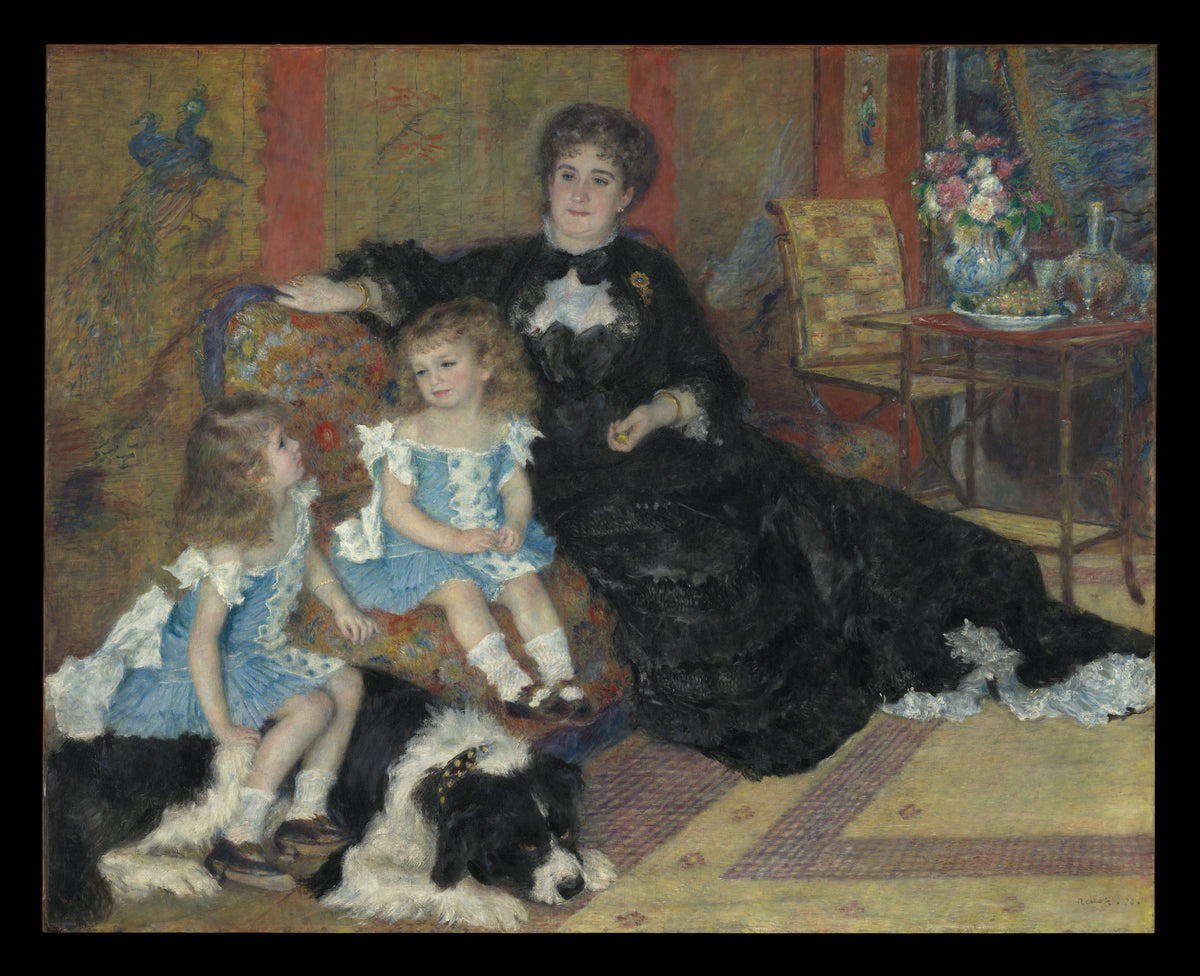
MUGG-120 — Auguste Renoir, Madame Georges Charpentier (Marguerite-Louise Lemonnier, 1848–1904) and Her Children, Georgette-Berthe (1872–1945) and Paul-Emile-Charles (1875–1895) (1878)
MUGG-120 — Auguste Renoir, Madame Georges Charpentier (Marguerite-Louise Lemonnier, 1848–1904) and Her Children, Georgette-Berthe (1872–1945) and Paul-Emile-Charles (1875–1895) (1878)
Regular price
$22.00 AUD
Regular price
Sale price
$22.00 AUD
Quantity
Couldn't load pickup availability
Fabric. Acquisition 4 of 4.
Renoir painted the Charpentier commission in 1878 knowing it would secure his re-entry to the Salon, and it did: Marguerite Charpentier's social influence guaranteed the work a prime hanging position in 1879, bypassing the jury's usual hostility toward Impressionist submissions. The painting is, in practical terms, a career transaction rendered in oil on a canvas over five feet wide.
What has occupied textile historians is Renoir's treatment of the upholstery and dress fabrics, each surface receiving a distinct optical weight. The Japanese-inflected cushions behind the children carry a looser, drier brushwork than the dense satin of Madame Charpentier's black gown, where Renoir loaded the brush to replicate how silk absorbs and redirects gaslight. As the final acquisition in a four-part series on the rendering of cloth, the work completes a sequence that began with damask and woven thread, arriving now at painted fabric, where the behaviour of textiles is performed entirely by pigment. MUGG-119 addressed actual silk construction in a Edo-period kosode; the present work addresses the illusion of it. The original remains at @metmuseum in New York. The ceramic is more portable.
***
This work entered the collection on 2026-08-20. The mug is the acquisition. The acquisition is complete.
Specifications
Ceramic mug, 11oz. Dishwasher safe and microwave safe. Print wraps include the artwork panel and museum label panel on a white ceramic base. Fulfilled by Gelato and ships in 3 to 5 business days.
Renoir painted the Charpentier commission in 1878 knowing it would secure his re-entry to the Salon, and it did: Marguerite Charpentier's social influence guaranteed the work a prime hanging position in 1879, bypassing the jury's usual hostility toward Impressionist submissions. The painting is, in practical terms, a career transaction rendered in oil on a canvas over five feet wide.
What has occupied textile historians is Renoir's treatment of the upholstery and dress fabrics, each surface receiving a distinct optical weight. The Japanese-inflected cushions behind the children carry a looser, drier brushwork than the dense satin of Madame Charpentier's black gown, where Renoir loaded the brush to replicate how silk absorbs and redirects gaslight. As the final acquisition in a four-part series on the rendering of cloth, the work completes a sequence that began with damask and woven thread, arriving now at painted fabric, where the behaviour of textiles is performed entirely by pigment. MUGG-119 addressed actual silk construction in a Edo-period kosode; the present work addresses the illusion of it. The original remains at @metmuseum in New York. The ceramic is more portable.
***
This work entered the collection on 2026-08-20. The mug is the acquisition. The acquisition is complete.
Specifications
Ceramic mug, 11oz. Dishwasher safe and microwave safe. Print wraps include the artwork panel and museum label panel on a white ceramic base. Fulfilled by Gelato and ships in 3 to 5 business days.
Share